
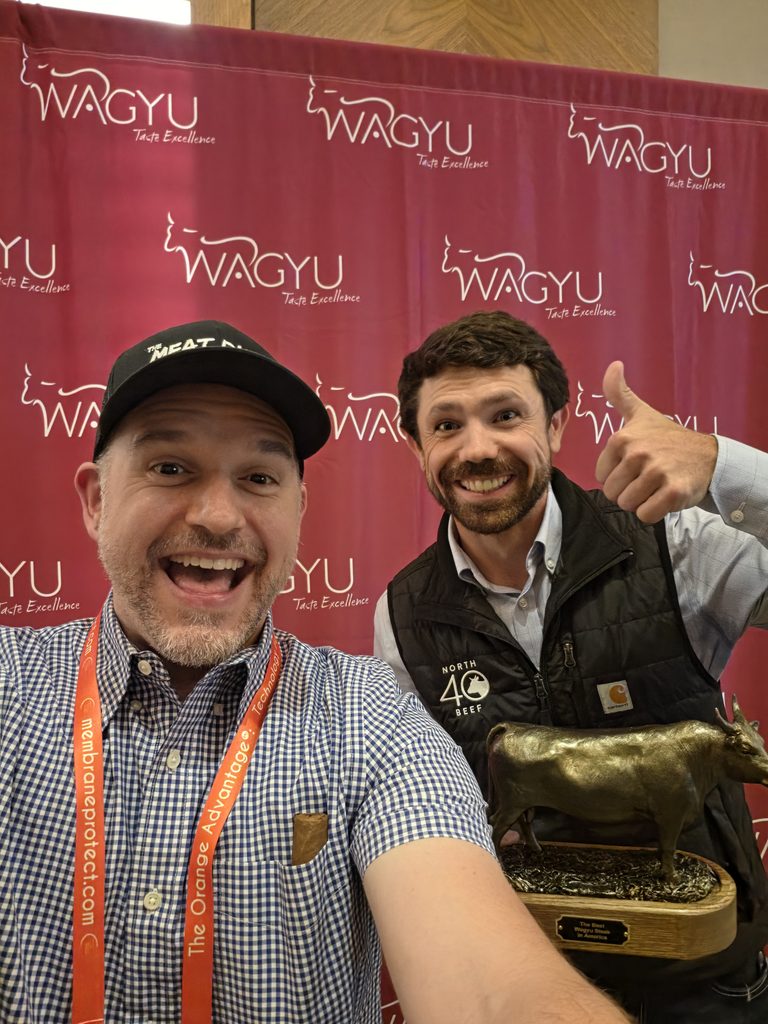
What does it take to produce the Best Wagyu Steak in America? For North 40 Beef in northeastern Nebraska, the answer involves years of careful breeding, locally sourced feed, patience, and an obsession with producing an incredible eating experience. After winning both the People’s Choice Award and the Best Wagyu Steak in America competition at the 2026 American Wagyu Association convention in Oklahoma City, North 40 Beef joined The Meat Dudes podcast to explain how it all came together.
We sat down with Logan Peters and Alex Heine to talk about their family farming backgrounds, their approach to raising American Wagyu, and why they believe the future of Wagyu beef is about much more than marbling.
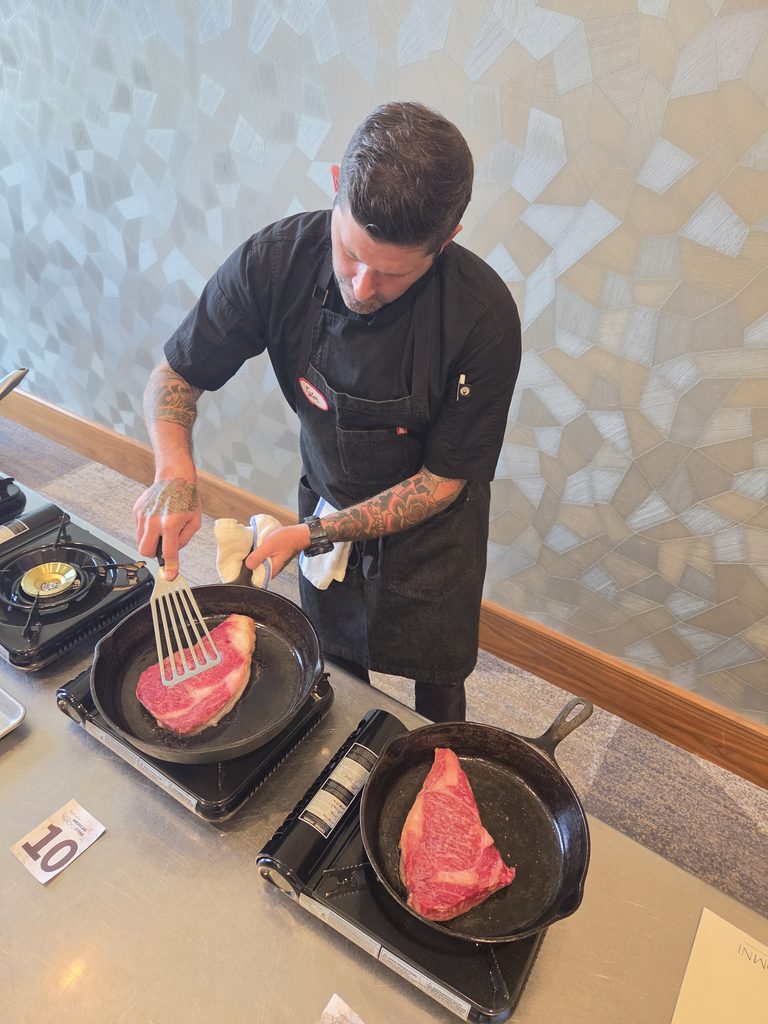
And considering we were there cooking and judging the competition, we had plenty of questions.
Winning More Than a Marbling Contest
There were some incredible steaks at the American Wagyu Association convention. We’re talking about ribeyes with marbling that would make just about any beef lover stop and stare.
North 40 stood out twice.
First, they took home the People’s Choice Award, recognizing the visual appeal of their steak. Then they won the Best Wagyu Steak in America competition, where the eating experience mattered just as much as appearance.
During our conversation, Logan and Alex pointed to one characteristic they believe helped distinguish their ribeye: the fineness of its marbling.
Rather than simply having large deposits of intramuscular fat, their winning steak featured exceptionally fine, snowflake-like marbling distributed throughout the muscle.
That distinction matters because Wagyu shouldn’t be judged solely by how much fat is visible in a steak. The distribution of that fat, the texture of the meat, and the resulting flavor all contribute to the final experience.
For us, that’s what made the win so interesting. North 40 produced a steak that looked incredible and delivered when it was time to eat.
From a Nebraska Family Farm to Award-Winning Wagyu
North 40 Beef operates primarily around Pender, Nebraska, combining the experience of two families with deep roots in cattle production.
Logan comes from a multigenerational family farming operation, while Alex brings experience from a family feedlot operation farther north, near the South Dakota border.
Their partnership is built around something pretty straightforward: raise exceptional cattle, maintain control over the process, and bring that beef directly to consumers.
But Logan’s introduction to Wagyu wasn’t exactly part of some grand business plan.
Back in 2010, he purchased Angus cows that had been bred to Wagyu. When the calves arrived, he wasn’t initially convinced they were going to be particularly valuable. They looked different from the conventional cattle he was accustomed to raising.
He eventually advertised them on Craigslist.
That led to a relationship with a buyer in Iowa who was finishing Wagyu cattle for restaurants and grocery stores. The buyer was willing to pay a premium, and Logan began recognizing the opportunity to produce something different.
Over time, he expanded his involvement in Wagyu genetics.
When Alex and Logan later discussed building a beef business together, Alex still wasn’t entirely convinced about Wagyu.
So Logan brought over some New York strips.
They grilled the steaks, tasted them, and the decision became a whole lot easier.
Sometimes the best business pitch is a really good steak.
What North 40 Beef Feeds Its Wagyu Cattle
One of the most interesting parts of our conversation was North 40’s feeding philosophy.
Nebraska is cattle-feeding country, and North 40 embraces the resources available in its own backyard.
Their cattle are finished on a locally sourced, corn-heavy ration that includes corn, corn silage, distillers grains from ethanol production, corn stalks, vitamins, and supplements.
They’re proud to raise corn-fed, corn-finished Wagyu.
But the feeding program is only part of the equation.
Logan and Alex explained that genetics, animal age, days on feed, nutrition, and animal handling all contribute to the final product.
They place particular emphasis on patience.
Even cattle with outstanding Wagyu genetics need sufficient time on feed to develop their marbling potential. Harvesting an animal too early can mean missing out on some of the qualities those genetics were capable of producing.
North 40 also emphasizes low-stress animal handling and keeping cattle comfortable throughout the raising process.
Their philosophy is that exceptional Wagyu isn’t created by one decision. It’s the result of getting a long series of decisions right.
And while North 40 believes strongly in its corn-finishing program, Logan and Alex were equally clear that they respect ranchers using different approaches.
Grass-finished, grain-finished, different breeds, different regions—there’s room for all of it.
That’s something we appreciate at The Meat Dudes. The goal isn’t to make every Wagyu steak taste the same. It’s to understand why each ranch produces the beef it does.
Why North 40 Focuses on F1 American Wagyu
North 40 raises Fullblood and Purebred Wagyu, but its primary focus is producing high-quality F1 Wagyu crossed with Angus.
F1 Wagyu is a first-generation cross, typically combining 50% Wagyu genetics with 50% genetics from another breed.
In North 40’s case, the combination brings together the rich marbling potential of Wagyu and the familiar, robust beef flavor associated with Angus.
Logan and Alex believe this creates an excellent balance between quality, flavor, and affordability.
They aren’t simply trying to produce the most expensive steak possible.
They’re trying to produce American Wagyu that more people can experience.
That means selecting the right genetics, developing a feeding program that supports marbling, and allowing the cattle enough time to reach their potential.
They described their F1 program as producing beef that can reach marbling levels approaching some Purebred cattle while remaining more accessible to everyday consumers.
It’s an important part of the conversation around American Wagyu.
Not everyone is looking for an intensely rich Fullblood ribeye for a special occasion. Sometimes you want a beautifully marbled steak with substantial beef flavor that you can cook on a Tuesday night.
There’s a place for both.
The Denver Steak Might Be North 40’s Biggest Surprise
Here’s something we loved hearing during the episode.
North 40’s most in-demand product isn’t necessarily the ribeye or New York strip.
It’s the Denver steak.
The Denver, also known as the Zabuton, comes from the chuck and offers excellent marbling, tenderness, and a satisfying beefy texture.
It’s one of those cuts that really demonstrates how Wagyu genetics can elevate muscles that consumers might otherwise overlook.
Logan and Alex explained that, earlier in their business, they sometimes had too much ground beef and were grinding cuts that deserved to be sold as steaks.
As more customers discovered what Wagyu could offer beyond traditional steakhouse cuts, that started to change.
Today, their Denver steak has become a customer favorite.
We see the same thing at The Meat Dudes Meat Shop. The Denver is one of those cuts that gets people excited once they actually cook and taste it.
We also talked about top sirloin, flat iron, skirt steak, and flank steak.
These cuts offer different textures, flavors, and price points, and they can deliver an outstanding Wagyu experience without requiring someone to spend ribeye money every time they want steak.
That’s one of the biggest opportunities for American Wagyu: introducing people to the entire animal, not just the most famous cuts.
What Does Nebraska Wagyu Actually Taste Like?
Something we’ve become increasingly interested in while cooking and tasting Wagyu from around the country is the idea of terroir.
It’s a term more commonly associated with wine, but the underlying idea is worth exploring with beef.
Where an animal is raised, what it eats, how it’s managed, and its genetics can all influence the final eating experience.
North 40’s Nebraska corn-finishing program is an important part of its identity.
During the podcast, we discussed how corn-fed beef can offer a familiar, recognizable flavor profile to American consumers while Wagyu genetics bring additional richness and marbling.
For someone trying Wagyu for the first time, that combination can be a great introduction.
And it’s also why we’re so interested in tasting beef from different ranches across the country, and why we are launching The Meat Dudes Approved Wagyu Map in December of 2026!
Nebraska Wagyu doesn’t have to taste exactly like Wagyu raised in Oregon, Texas, Vermont, or Florida.
Those differences are part of what makes exploring American Wagyu so interesting.
Is Wagyu Beef Healthier? Looking Beyond Marbling
We also got into a conversation about Wagyu fat composition and the importance of looking beyond total marbling.
North 40 discussed its participation in the Triple Crown steak competition in California, where its Fullblood entry performed particularly well in measured fat-quality categories.
According to Logan and Alex, their entry recorded the highest oleic acid percentage, the strongest monounsaturated-to-saturated fat ratio, and the lowest fat melting point among the Fullblood steaks submitted.
Those results are interesting because they highlight characteristics that aren’t visible when someone simply looks at a raw ribeye.
Fat composition and melting characteristics can influence how a steak eats, and they’re worth studying alongside marbling and flavor.
Of course, nutritional comparisons require more context than a single competition result, and Wagyu is still beef to enjoy as part of a balanced diet.
But it’s another reason we think the conversation about Wagyu quality should go deeper than a marbling photograph.
The Future of American Wagyu Is About More Than Expensive Steaks
One of the recurring themes throughout this episode was accessibility.
For years, plenty of consumers have associated Wagyu with extraordinarily expensive Japanese A5 beef served in small portions at luxury restaurants.
And while that experience absolutely has its place, it represents only one part of the Wagyu world.
North 40 wants consumers to understand that American Wagyu can also be an approachable, everyday eating experience.
They work with restaurants, sell directly to consumers, and offer a variety of cuts and products, including ground beef, burger patties, and bratwurst.
They also see chefs as an important part of introducing more people to Wagyu.
When a neighborhood restaurant puts a great Wagyu Denver steak or top sirloin on the menu, customers have an opportunity to experience something new without committing to an expensive specialty steak.
That first great bite can change someone’s entire perception of Wagyu.
Logan and Alex would love to see American Wagyu become more common on restaurant menus across the country over the next decade.
We agree.
But we also want consumers to know who’s raising that beef, how they’re raising it, and what makes each producer different.
That’s how the industry grows without losing the connection between ranchers and the people enjoying their products.
The Team Behind the Best Wagyu Steak in America
Toward the end of the conversation, Logan and Alex made a point that deserves more attention.
Winning a major Wagyu competition isn’t the work of one person.
Behind that steak is an entire network of family members, cattle producers, genetic specialists, veterinarians, nutritionists, processors, and other people contributing to the operation.
It takes years to develop the genetics, raise the cattle, manage the feeding program, and produce a finished steak capable of competing at that level.
North 40 was quick to share credit with the people who helped make the achievement possible.
And that says a lot about the operation.
Winning Best Wagyu Steak in America is a tremendous accomplishment. But understanding the work, patience, and people behind the steak makes the story even better.
Listen to the Full North 40 Beef Podcast
This episode of The Meat Dudes is a great conversation about what it takes to produce exceptional American Wagyu, why F1 Wagyu deserves more attention, and how ranchers like Logan Peters and Alex Heine are helping move the industry forward.
From a few Wagyu-cross calves sold on Craigslist to producing the Best Wagyu Steak in America, North 40’s story is a reminder that great beef doesn’t happen by accident.
Check out the full episode of The Meat Dudes podcast, and visit North 40 Beef to learn more about their operation and available Wagyu beef.
WAGYU, It’s just better beef.