

Is Wagyu beef healthy? It’s one of the biggest questions we get about Wagyu, and it makes sense. Look at a beautifully marbled Wagyu steak and you can physically see the fat running through it. For decades, most of us have been taught a pretty simple equation: fat = bad. But when you actually dig into the science, it turns out that not all fat is the same—and the composition of Wagyu fat is one of the things that makes this beef so interesting.
On The Meat Dudes Podcast, we sat down with Tanya Pieterse and Professor Edward Webb, who were involved with the World Wagyu Council’s 2025 Health Benefits of Wagyu Beef project, to help us understand what the research actually says.
We wanted to get past the marketing claims and ask some straightforward questions.
What makes Wagyu fat different? What is oleic acid? What are monounsaturated fats? And can we actually say that Wagyu beef is healthy?
Let’s get into it.
Why Does Wagyu Have So Much Fat?
First, we need to talk about what makes Wagyu look so different from conventional beef.
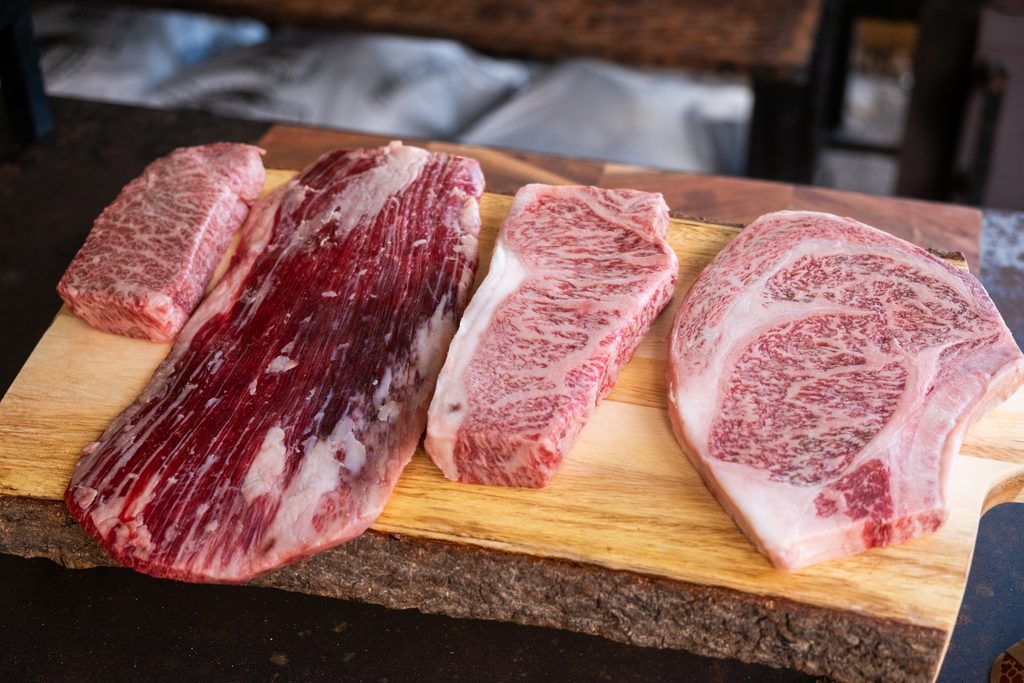
Wagyu is famous for intramuscular fat, better known as marbling. Those are the streaks and flecks of fat running through the muscle.
Professor Webb explained that Wagyu can carry considerably more intramuscular fat than conventional beef. That fat contributes to the tenderness, juiciness, richness, and eating experience that makes Wagyu famous.
But seeing all that marbling creates an obvious question:
How can something with that much visible fat possibly have health benefits?
The answer starts with understanding that fat isn’t just fat.

Not All Fat Is the Same
This was probably our biggest takeaway from the entire conversation.
There are different types of fatty acids, including saturated, monounsaturated, and polyunsaturated fats. Their proportions and structures matter.
Professor Webb explained that the common perception that animal fat is entirely saturated isn’t accurate. He said that in bovine fat, approximately 52% of the fatty acids are unsaturated, with Wagyu tending toward an even higher proportion of unsaturated fatty acids.
And that’s where Wagyu starts getting really interesting.
Wagyu is particularly known for its proportion of monounsaturated fatty acids, including oleic acid.
If oleic acid sounds familiar, there’s a reason. It’s also a prominent fatty acid in foods such as olive oil.
That doesn’t mean a Wagyu steak is nutritionally identical to olive oil. It obviously isn’t.
But it does help explain why looking at a Wagyu steak and simply saying, “That’s a lot of fat, so it must be bad for you,” misses a big part of the picture.
What Is Oleic Acid in Wagyu Beef?
Oleic acid is a monounsaturated omega-9 fatty acid.
Professor Webb explained that Wagyu tends to have a favorable proportion of oleic acid compared with conventional beef and discussed how these fatty acids relate to lipid transport and cholesterol metabolism in the body.
Oleic acid also helps explain something you can physically experience when cooking Wagyu: the fat melts differently.
Tanya explained that the fatty-acid composition contributes to Wagyu fat’s lower melting point. That’s part of the reason heavily marbled Wagyu can begin rendering so quickly when it hits a warm pan—or sometimes even begin softening at room temperature.
If you’ve cooked a beautifully marbled Wagyu steak, you’ve seen this firsthand.
You usually don’t need to dump a bunch of cooking oil into the pan.
The steak brings plenty of its own.
What About Omega-3, Omega-6 and Omega-9?
We hear about omega-3 fatty acids all the time.
Omega-6 gets talked about quite a bit too.
But omega-9 doesn’t seem to get nearly as much attention.
During our conversation, Professor Webb explained that the fatty-acid profile of beef includes omega-3, omega-6, and omega-9 fatty acids and highlighted Wagyu’s contribution of oleic acid, an omega-9 fatty acid.
This is another reason we need to get away from thinking about food as simply “fat” or “no fat.”
The actual composition matters.
So, Is Wagyu Beef Healthy?
Back to our focus question: Is Wagyu beef healthy?
The answer from our guests was essentially yes—with an important word attached:
Moderation.
Professor Webb described Wagyu as having a favorable fatty-acid profile and emphasized that it can fit into a healthy diet. But both he and Tanya repeatedly stressed that they aren’t recommending people eat unlimited Wagyu—or unlimited amounts of any food.
That’s important.
We’re not going to tell you that eating a three-pound Wagyu tomahawk every night is your new health plan.

Sorry, dude.
The point is that the visible marbling in Wagyu doesn’t automatically make it an unhealthy food.
A balanced diet still matters. Portion size matters. Your overall lifestyle matters.
Wagyu can simply be part of that equation.
Wagyu Isn’t a Miracle Food
This is something we really appreciated about the World Wagyu Council’s approach.
There are some pretty wild claims floating around the Wagyu world.
We wanted to know what the science actually supports.
Tanya explained that much of the existing research used for the project came from Japan, Australia, and the United States. She also pointed out an important limitation: more direct human trials would be valuable for understanding how these findings translate into specific human-health outcomes.
That’s a big distinction.
Research into the fatty-acid composition of Wagyu can tell us a lot about the beef itself.
Making a claim that eating Wagyu will directly prevent a particular disease is a much bigger step.
We’re interested in the science, not turning a steak into a miracle drug.
Is American Wagyu Healthy Too?
Another question we wanted answered was whether these potential benefits apply only to Japanese Wagyu.
Because Wagyu isn’t raised only in Japan.
It’s raised in the United States, Australia, South Africa, the United Kingdom, and many other countries.
Tanya was careful about this point. You can’t say every Wagyu animal everywhere in the world has the exact same fatty-acid profile. Genetics, production systems, environment, and other factors can create differences between animals and beef. Professor Webb added that because cattle are ruminants, diet generally has a smaller effect on fatty-acid composition than people might assume, with differences often showing up more in the amount of fat deposited.
That’s another reason we always come back to:
Not every Wagyu steak is identical.
And that’s okay.
Why Did Red Meat Get Such a Bad Reputation?
For decades, many people were told to avoid red meat and animal fat because of concerns around saturated fat, cholesterol, and cardiovascular disease.
Professor Webb explained that dietary recommendations have evolved considerably as nutrition research has developed. The conversation has become much more nuanced than simply labeling all animal fat or all red meat as unhealthy.
That’s really the point of this entire conversation.
Nutrition is complicated.
“Fat = bad” is easy to remember.
But easy doesn’t necessarily mean accurate.
Wagyu Is More Than Marbling
When people first discover Wagyu, the marbling gets all the attention.
We understand why. It looks incredible.
But the more we’ve learned about Wagyu over the past several years, the more interesting the story becomes.
It’s genetics.
It’s tenderness.
It’s flavor.
It’s how the fat renders.
It’s where the animal was raised.
It’s the rancher.
It’s the cut.
And now we’re learning more about the actual composition of that fat.
That’s a much more interesting story than simply trying to find the steak with the most white stuff running through it.
Making Wagyu Easier to Understand
This is also exactly why we’re building the Meat Dudes Approved Wagyu Map.
There is so much confusing information surrounding Wagyu.
American Wagyu. Japanese Wagyu. F1. Purebred. Fullblood. Japanese Black. Akaushi. BMS scores. Marbling. Genetics. Fat composition.
It can get intimidating really damn fast.
We want to make it easier.
We’re cooking Wagyu from ranches across the United States, learning about how they’re raising their cattle, tasting different cuts, and showing people how to cook them.

You shouldn’t need a degree in meat science to buy a great steak.
But if you WANT to nerd out about meat science?
Well, we’re here for that too.
The Bottom Line: Is Wagyu Beef Healthy?
So one last time: Is Wagyu beef healthy?
The biggest takeaway from our conversation with Tanya Pieterse and Professor Edward Webb is incredibly simple:
Not all fat is the same.
Wagyu’s marbling contains a significant proportion of unsaturated fatty acids, including monounsaturated fats such as oleic acid. The research discussed by our guests suggests Wagyu has a favorable fatty-acid profile, while they also emphasized moderation, a balanced diet, and the need for continued research into specific human-health outcomes.
So don’t be scared of the marbling.
Learn what it is.
Learn where your beef comes from.
Cook it properly.
And enjoy some really damn good beef.
Wagyu is a spectrum.
It’s just better beef.