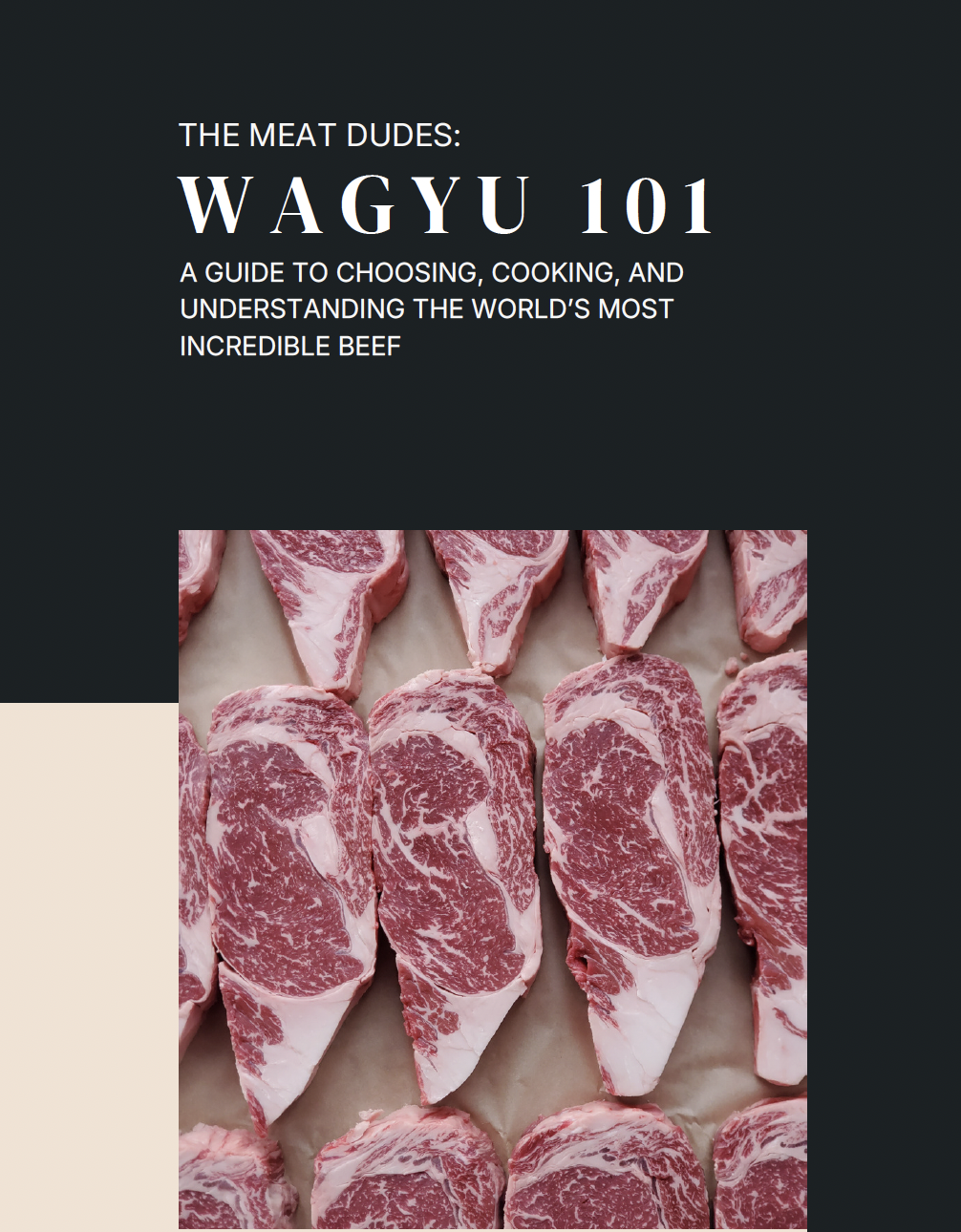


Today we’re breaking down the Wagyu Myths Busted list that every consumer needs to understand before buying their next steak.
Wagyu beef is everywhere right now — on social feeds, restaurant menus, butcher counters, and backyard grills. And with that hype comes confusion. After years of working with Wagyu every day in the butcher shop, talking with ranchers, and interviewing experts on The Meat Dudes Podcast, I’ve heard every myth you can imagine.
Today we’re breaking down the 10 biggest Wagyu myths, why they’re wrong, and what you actually need to know when you buy or cook Wagyu beef.
Myth #1: Wagyu cattle are massaged and fed beer every day.
This is the most famous Wagyu myth — and the most wrong.
Are Wagyu cattle taken care of extremely well?
Absolutely.
Do ranchers massage their cows daily while feeding them craft beer?
Absolutely not.
Good ranchers focus on low-stress environments, quality feed, and proper animal husbandry. Stress raises cortisol, and cortisol affects marbling and tenderness — so keeping Wagyu calm and comfortable matters.
But the idea that every Wagyu cow is getting drunk and getting spa treatments is just marketing mythology that stuck around for decades.
Myth #2: Wagyu only comes from Japan.
The genetics originate from Japan — that part is true.
But Wagyu cattle are now raised all over the world:
- United States
- Australia
- South America
- Europe
If the genetics trace back to Japanese Wagyu lines and are verified, that animal can be full-blood Wagyu no matter where it’s raised.
So yes, a full-blood Wagyu cow raised in Texas is still Wagyu.
Myth #3: American Wagyu is fake.
This one needs to die.
“American Wagyu” doesn’t mean 50/50 Wagyu-Angus (though many F1 crosses are). It simply means Wagyu raised in America, whether it’s:
- Full-blood (100% Wagyu genetics)
- Purebred (93.75%+)
- F1 cross (50%)
- Other verified Wagyu crosses
If the genetics are authenticated through credible organizations (AWA, Triple Crown Steak Challenge, etc.), it’s absolutely real Wagyu raised in the U.S.
Myth #4: Wagyu means A5
A5 is one type of Wagyu — the highest grade produced in Japan — but Wagyu is an entire family of cattle genetics.
Wagyu can include:
- F1 crosses (50% Wagyu)
- Purebred
- Full-blood raised outside Japan
- A3, A4, A5 grades
- Red Wagyu/Akushi crosses
- American-raised Wagyu with Japanese genetics
A5 is incredible, but it is not the only Wagyu. If you expect all Wagyu to look like the white, spiderwebbed A5 ribeyes you see on Google, you’re missing the whole spectrum.
Myth #5: Wagyu is unhealthy because it’s so fatty
Wagyu’s fat is different — in a good way.
Wagyu contains high levels of monounsaturated fats, omega-3s, omega-6s, and oleic acid — the same heart-healthy fats you find in salmon and olive oil.
No, eating 3 lbs of A5 won’t turn you into a wellness influencer. But if you compare protein sources:
Wagyu fat is closer to salmon fat than to typical beef fat.
That’s why it melts at a lower temperature and feels buttery instead of heavy.
These next stories are where misinformation spreads the fastest, so let’s keep the Wagyu Myths Busted momentum going.
Myth #6: Wagyu is too rich to enjoy
It depends on which Wagyu you’re eating.
- A5: extremely rich — a few ounces and you’re done
- Full-blood: still very rich — better shared
- F1 / American Wagyu: perfect as a full steak, incredible flavor, not overwhelming
Most people who say Wagyu is “too much” are talking about A5.
Most people who love Wagyu eat F1 or American Wagyu.
Myth #7: All Wagyu tastes the same
Absolutely not.
Wagyu reflects terroir, just like wine.
Where the animal is raised changes:
- The flavor
- The fat profile
- The texture
- The aroma
- The mouthfeel
Wagyu from Japan tastes different from Wagyu from Australia, which tastes different from Wagyu from the Midwest, which tastes different from Wagyu from the Pacific Northwest.
Even two ranchers 200 miles apart will produce different flavor profiles because their cattle eat different feed, forage, and minerals.
Myth #8: If it’s not super marbled, it’s not Wagyu.
Wagyu ? A5.
Not every cut from a Wagyu animal looks like a snowflake ribeye.
Examples of Wagyu cuts that are naturally leaner:
- Terrace major
- Tenderloin
- Ranch steak
- Top sirloin
All of these can be Wagyu with beautiful flavor but won’t look like Pinterest A5.
And yes — an F1 cross will look different than a purebred or full-blood ribeye. That doesn’t make it “not Wagyu.”
Myth #9: Only ribeyes and New York strips count as Wagyu.
Wagyu’s magic isn’t limited to the Hollywood cuts.
Some of the best Wagyu experiences come from the shoulder and chuck:
- Zabuton (Denver)
- Delmonico / Chuck steaks
- Ranch steaks
- Top sirloin
- Bavette
- Tri-tip
- Flank / Skirt (when you can find them)
These cuts are often cheaper, more approachable, and unbelievably good when sourced from Wagyu cattle.
If you’re only eating the ribeye, you’re missing half the fun.
Myth #10: Wagyu is only for rich people
Wagyu is a spectrum.
Sure — some cuts are $150–$300 a pound.
But Wagyu is not only luxury beef.
Affordable Wagyu exists:
- $10–$15 ranch steaks
- $15–$20 Zabuton or Bavette steaks
- $20–$30 top sirloin or Denver steaks
- F1 cross cuts that blow Prime Angus out of the water
You do not need a trust fund to enjoy great Wagyu. You just need a good butcher and a willingness to try cuts beyond the ribeye.
Final Thoughts: Get Curious, Ask Questions, Eat Better Beef
The Wagyu world is huge — genetics, cuts, feeding methods, terroir, grading scales, and price points all shape the experience. The best way to understand Wagyu is simple:
Try different cuts. Ask your butcher questions. Learn where your meat comes from. Explore the spectrum.
If you hear a new Wagyu rumor or misunderstanding, send it our way and we’ll add it to our ongoing Wagyu Myths Busted series.
Drop it in the comments.
We’ll bust it in the next round.