
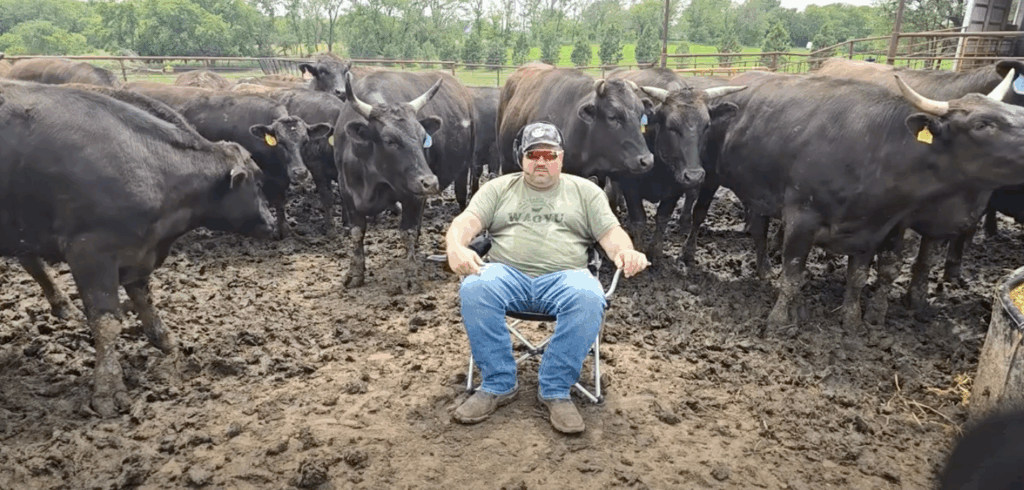
When you see docile Wagyu cattle standing calmly around a rancher instead of running the fence line, you’re seeing more than a personality trait — you’re seeing part of the quality equation. During our conversation with Adam Wackle of Plum Creek Wagyu in Nebraska, he was sitting in a finishing pen surrounded by 1,000–1,500 pound steers that were relaxed, curious, and completely at ease.
That calm behavior isn’t accidental. And according to Adam, docile Wagyu cattle are one of the most overlooked factors in producing high-quality beef.
What “docile” really looks like
This wasn’t a staged ranch photo. These were finishing steers, on feed, walking up to sniff the camera and casually licking the tripod. No pushing. No panic. No adrenaline.
Adam explained that Wagyu, when handled correctly, are naturally calm. He’s calved out hundreds and has never had a mother charge him while tagging a newborn. That’s a stark contrast to many commercial cattle operations where protective behavior can get intense fast.
But breed alone isn’t the whole story.
The fourth key to finishing cattle
Everyone talks about:
- Genetics
- Feed
- Environment
Adam adds a fourth: don’t let them be afraid of humans.
The more time cattle spend around people in a positive, consistent way, the less they spike cortisol and adrenaline during handling. And that carries all the way through harvest day.
In his operation, docile Wagyu cattle aren’t just easier to manage — they’re central to the end product.

Comfort drives performance
Adam noticed something years ago: during Nebraska summers, cattle would stall in weight gain or even lose weight. Same feed. Same genetics. But too much heat and stress.
So he invested in shade access, airflow, and a setup that lets cattle move in and out of a barn freely. Once comfort improved, summer gains returned.
Calm animals eat consistently. Consistency leads to better finishing.
What they’re fed — and how they’re fed
Plum Creek Wagyu cattle are on free-choice feed 24/7:
- A ration that’s roughly 60–70% corn
- Unlimited wheat straw
- A complete mineral and vitamin pack
- Reduced vitamin A during finishing to enhance marbling
The key detail? They aren’t forced to eat on a rigid schedule. Automatic feeders stay full. They eat, rest, eat again — more like grazers than competitive feeders.
Adam pointed out that in many commercial systems, cattle compete aggressively for feed. Here, there’s no competition. That reduces stress even further.
Corn-fed vs grass-fed — a common misconception
One thing Adam hears constantly: “Is it grass-fed?”
There’s a strong public perception that grass-fed automatically equals better or healthier. Adam’s perspective is that if your goal is rich marbling and a classic Wagyu eating experience, finishing on a controlled, high-quality ration produces a different — and often preferred — result.
The real issue isn’t grass vs grain. It’s management and transparency.
Can Wagyu scale without losing this?
As Wagyu grows in popularity, the big question becomes: can this calm, hands-on approach scale?
Adam believes it can — but not by copying conventional feedlot models. It requires intentional facilities, manpower, and patience. You can’t rush Wagyu. He even calls moving them “Wagyu time.” You open the gate and let them move at their pace.
That philosophy reinforces what we saw firsthand: calm animals, steady gains, no chaos.
Why this matters on your plate
Stress affects animals physiologically. Elevated adrenaline and cortisol impact metabolism, feed efficiency, and potentially eating experience.
Adam’s belief is simple: the closer you can raise cattle to a low-stress, comfort-first model, the better your chances of producing exceptional beef.
And after seeing those steers calmly gathered around him, it’s hard to argue that temperament doesn’t matter.
If you’re buying Wagyu, ask how it’s raised — not just what the marbling score is.